Why Anthropic PMs Stopped Writing PRDs (and Started Shipping in 45 Minutes)
Why Anthropic PMs Stopped Writing PRDs (And Started Shipping in 45 Minutes)
If you're still crafting lengthy strategy documents, your career may already be at risk.
This article reveals how leading organizations like Anthropic and Shopify are revolutionizing their workflows.
The Problem with Traditional Product Management
Typical Product Managers dedicate about 40% of their week to tasks such as drafting Jira tickets, updating roadmaps, and dissecting lengthy Product Requirements Documents (PRDs).
Yet, at cutting-edge AI companies like Anthropic, Senior Product Managers have completely eliminated this from their schedules.
A New Approach to Product Management
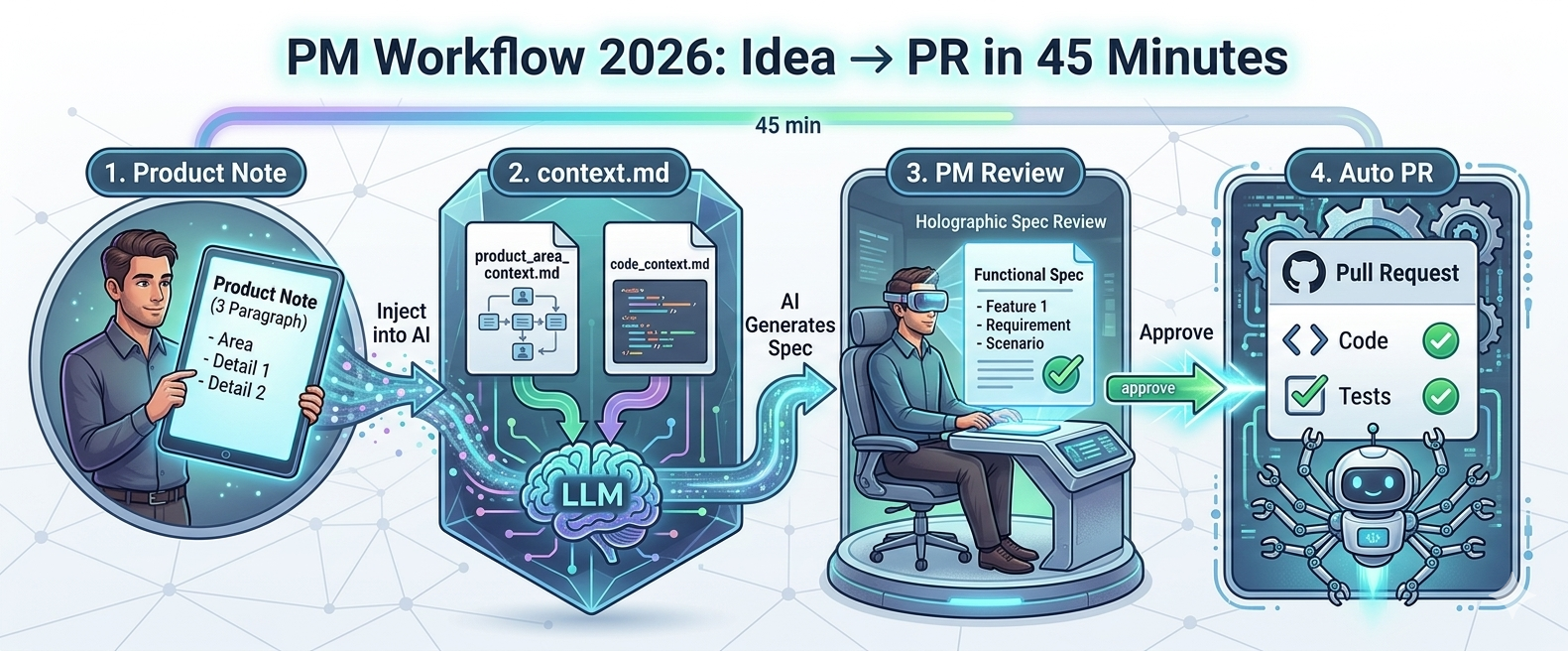
Here, a Product Manager simply conceives an idea and drafts a brief, three-paragraph Product Note.
This note is then entered into an automated agent-driven workflow. In just 45 minutes, a functional and tested Pull Request (PR) is ready in GitHub for engineering review.
There's no need for refinement meetings, extensive PRDs, or lengthy development cycles.
This is not a futuristic forecast for 2030. This transformation is occurring right now.
Understanding the Execution Collapse
The "Execution Collapse" signifies a dramatic reduction in the cost and time required to transform a product concept into production-ready code.
To thrive in the upcoming tech landscape, professionals must transition into "Orchestrators."
Orchestrators bypass PRDs in favor of crafting context.md files.
The Product Management Workflow of the Future
Step 1: Crafting the Product Note
Forget about PRDs. Now, you create a “Product Note.”
This concise, 3-to-4 paragraph document outlines user intent, desired outcomes, and specific metrics, focusing purely on strategy without implementation details.
Step 2: Contextual Injection
This step involves feeding the Product Note into an orchestrating LLM, along with two crucial system files to prevent AI misinterpretations:
-
product_area_context.md: Managed by the PM, this file outlines strict business rules, such as user limitations and tone guidelines.
-
code_context.md: Managed by the engineering lead, it details the current technical framework, such as programming languages and database schemas.
Step 3: Creating and Reviewing the Functional Spec
The Orchestrator LLM combines the Product Note with the Context files to produce a detailed Functional Spec.
The PM’s role shifts to analyzing and editing this spec, ensuring compliance with the business rules and technical realities. The PM acts as an editor, refining the AI's output.
Once satisfied, the PM approves the spec.
Step 4: From Tech Spec to Autonomous Pull Request
After approval, the workflow becomes fully autonomous:
- The Functional Spec is transformed into a Tech Spec, outlining architecture and data models.
- A coding model (e.g., Claude 4.6) writes the code, performs unit tests, and generates a Pull Request in GitHub.
- Total process time: 45 minutes.
The Future of Product Management
Review this workflow. Notice the absence of backlog refinement meetings and Jira user stories.
The Execution Collapse signifies that engineering tasks are becoming commoditized.
In this new paradigm, organizations need not employ numerous Product Managers for sprint coordination. Instead, they require a few highly skilled PMs adept at structuring context.md files, evaluating AI logic, and orchestrating autonomous workflows.
Failure to adapt these pipelines will leave you trailing behind those who do.
Transition from Coordination to Orchestration
Recognizing this future is merely theoretical.
Building these agent-driven workflows for your own projects is crucial to navigating this transition successfully.