What is a RAG System?
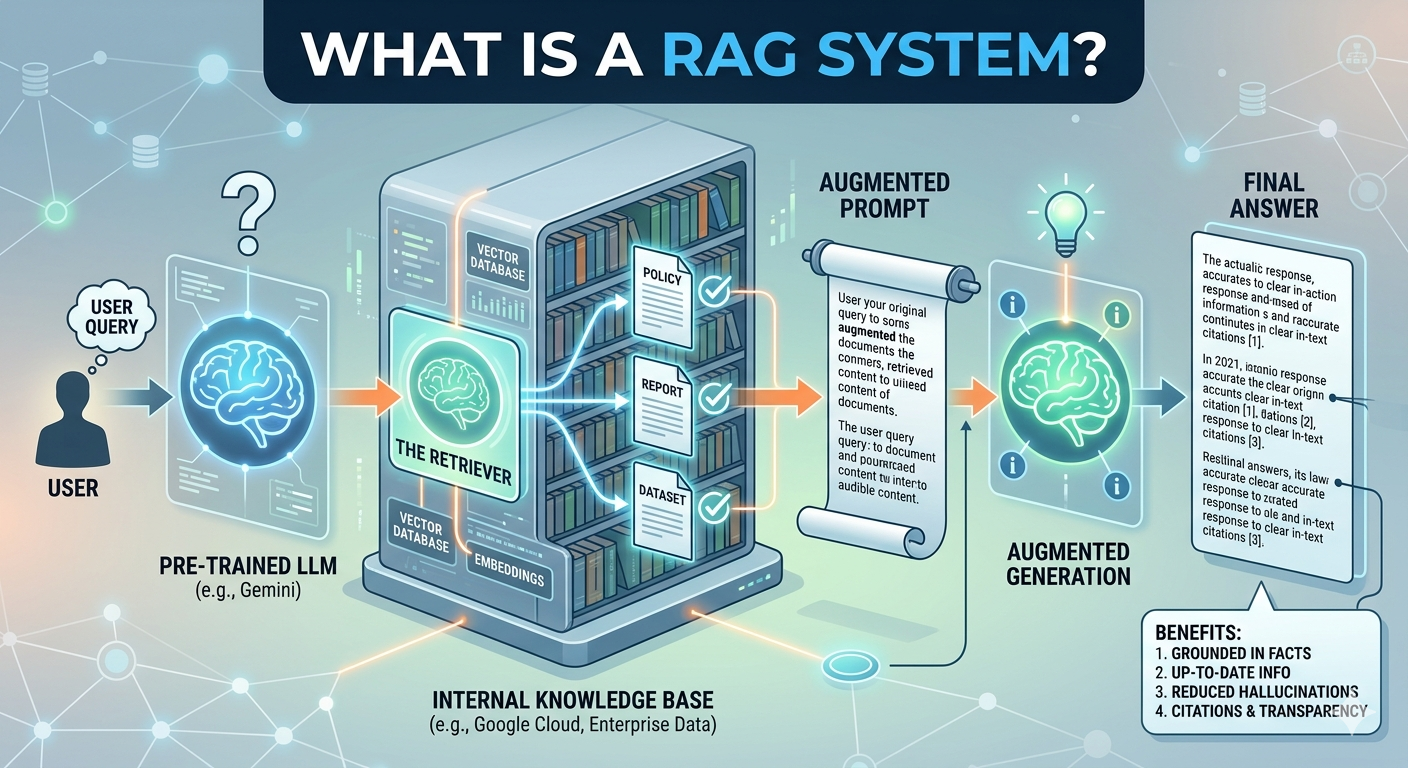
What is a RAG System?
Imagine posing a question to a knowledgeable professor who hasn't updated their knowledge with recent news. Their answer, although confident, might be outdated. This scenario highlights a challenge faced by large language models, a challenge that Retrieval-Augmented Generation (RAG) aims to overcome.
RAG is an innovative architecture designed to enhance AI's capability by allowing it to consult external sources before generating responses. Instead of solely depending on pre-trained data, a RAG model searches a knowledge base—be it a database, document repository, or live web index—to ground its answers with the most current information. This process results in more accurate and transparent AI outputs.
Addressing Critical Challenges
Large language models, or LLMs, are trained on vast collections of text, but once trained, their knowledge becomes static. This means they can't account for events occurring after their training period, potentially leading to fabricated answers—an issue known as hallucination. Moreover, these models lack access to proprietary information, such as a company's internal data or recent research, hindering their utility in enterprise environments.
RAG tackles these challenges by providing the model with real-time access to external information, enabling it to retrieve necessary context just before crafting a response. This approach doesn't increase the model's inherent intelligence but rather enriches its informational foundation at the critical moment.
How Does a RAG System Operate?
Although the engineering behind RAG is complex, its conceptual design is straightforward and mirrors human problem-solving: gather information first, then respond.
RAG Pipeline Overview:
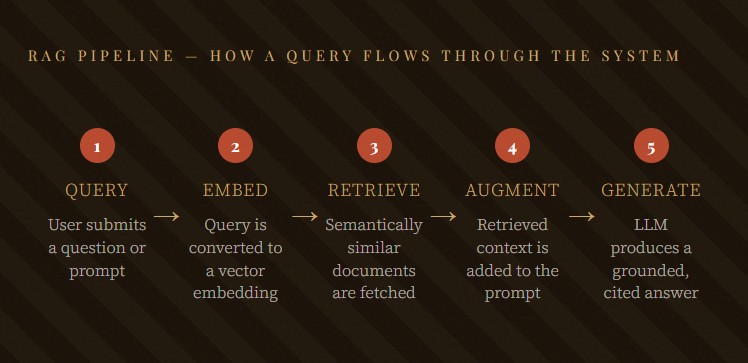
Step One: Indexing the Knowledge Base
For RAG to function, the knowledge base—comprising documents like PDFs, web pages, and internal wikis—must be pre-processed and stored for quick semantic search. Documents are broken into smaller segments, each converted into a vector embedding that represents its meaning. These embeddings are stored in specialized databases like Pinecone or Weaviate.
Step Two: Retrieval During Query
When a question is submitted, it gets encoded into a vector using the same model. A semantic search is conducted to find document segments whose embeddings closely match the query, ensuring relevant information is retrieved.
Step Three: Augmented Response Generation
The retrieved segments are incorporated into the language model's prompt along with the original question. This equips the model with a curated set of information, enabling it to provide accurate and referenced answers without relying on memory alone.
The Growing Necessity of RAG
RAG's emergence signifies an evolution in AI deployment strategies. While initial adopters found general-purpose chatbots impressive, they soon realized the risks when these bots operated in contexts demanding precision or domain-specific knowledge. A bot quoting an outdated policy can be detrimental.
RAG addresses this by making AI responses verifiable. Because each answer can be traced back to original documents, it's easier to update and audit the knowledge base without retraining the model. This traceability is crucial in sectors like healthcare and finance, where compliance and trust are paramount.
Exploring Advanced RAG Techniques
The basic RAG framework, sometimes referred to as naive RAG, has been expanded through ongoing research. Advanced techniques enhance retrieval quality via query rewriting, re-ranking results, and hybrid searches combining dense vector similarities with traditional keyword methods.
Modular RAG takes it further, allowing the retrieval component to be flexible, enabling iterative processing for more refined results. GraphRAG, developed by Microsoft Research, integrates knowledge graphs to enable deeper reasoning over interconnected concepts.
Important Limitations
RAG isn't a cure-all solution. Its effectiveness depends on the quality of the knowledge base. Inaccurate or poorly organized data can hinder retrieval performance. Additionally, the model’s context window limits how much retrieved information can be processed simultaneously.
Latency is another consideration. The RAG pipeline involves additional steps—embedding queries, searching databases, and formatting context—which can slow down response times compared to direct model queries. For time-sensitive applications, optimizing this process is essential.
For tasks requiring deep stylistic adaptation or complex reasoning, fine-tuning might still be necessary alongside RAG. Many production systems integrate both methods for optimal performance.
The Future of AI and Knowledge
RAG represents a shift in how AI systems manage knowledge. Instead of embedding all possible information during training, RAG maintains a lean model that can access information as needed. This approach likens AI to a skilled analyst with a vast library at their disposal, emphasizing the importance of knowing where to find information and how to use it effectively.
As context windows expand and retrieval methods improve, the distinction between AI "knowing" and "finding" will continue to blur. RAG will remain pivotal in this evolution, bridging the static knowledge within AI models and the ever-changing landscape of global information.