Answer Anything, Instantly: AI-Powered Knowledge Base for Modern Support Teams

Answer Anything, Instantly: AI-Powered Knowledge Base for Modern Support Teams
Envision integrating artificial intelligence within your company, where it enhances the efficiency of support teams by swiftly pulling information from your knowledge base and offering auto-complete suggestions. This AI marvel also summarizes interactions and handles straightforward questions automatically. With built-in chat features, it tackles routine queries and seamlessly escalates complex issues to human agents. This approach not only accelerates response times for customers but also minimizes repetitive tasks for staff, without disrupting their established workflow.
The Rise of AI Knowledge Bases
AI-driven knowledge bases are reshaping the way businesses manage and disseminate information to both clients and internal teams. Utilizing artificial intelligence, these systems provide quicker and more precise responses, significantly elevating customer satisfaction. Notably, top SaaS companies and global enterprises are embracing AI-enhanced knowledge platforms to streamline their support services and slash resolution times.
Understanding AI Knowledge Bases
An AI knowledge base is a smart digital repository powered by artificial intelligence. Unlike conventional documentation systems, these applications use machine learning and natural language processing to comprehend user inquiries, deliver pertinent information, and gradually improve through interaction.
For example, when faced with a complex question, the system assesses context and promptly retrieves relevant documents or suggests useful resources. This capability is advantageous not only for customers but also for internal teams such as support and sales, enabling them to find answers swiftly, thereby optimizing daily operations and onboarding processes.
Implementing an AI Knowledge Base
The typical process for deploying an AI knowledge base involves several steps:
-
Integration and Initial Setup: Start by integrating a knowledge base tool with your customer support system for initial efficiency gains, while assessing AI responses to identify gaps in knowledge.
-
Monitoring and Adjustment: Observe how the AI interacts with messages, allowing time to refine content and address gaps.
-
Feedback and Improvement: Use customer feedback to accelerate learning loops, identifying areas where AI struggles to resolve queries.
-
Escalation and Enhancement: Determine when to escalate issues to human agents and decide whether to enhance the knowledge base, connect backend systems, or integrate dynamic data.
In essence, an AI-powered knowledge base is a dynamic, responsive platform that enhances access to information through intelligent automation, benefiting both businesses and users.
Why Opt for an AI-Driven Knowledge Base?
Today's organizations face growing pressure to deliver information swiftly and accurately. An AI-driven knowledge base addresses this demand by cutting down the time employees and customers spend searching for answers. Many companies implement these systems to enable faster self-service for customers, thereby reducing dependence on human staff.
For instance, an online retailer might see a 30% reduction in support tickets after integrating AI-powered content management into its knowledge base, as customers independently find answers through intelligent search. This also aids support teams by providing immediate access to current documentation, allowing them to focus on complex issues that require human insight.
Preparing for AI Integration
Before deploying AI, it's essential to organize your existing knowledge base. If you have numerous articles, some outdated or contradictory, AI alone won't clean up disorganized content.
AI can assist with auditing your knowledge base using a language model to review articles, identify duplicates, broken links, or inconsistencies, and create a prioritized cleanup list.
Additionally, having a human review outdated pages, establish a content hierarchy, and determine relevance is crucial. Sole reliance on AI could lead to confusion. If feasible, hiring a technical writer, even on a temporary basis, can be highly advantageous.
Remember, the effectiveness of any AI system depends on the quality of the information it processes. Disorganized or contradictory content will yield poor responses. Once your knowledge base is tidy and organized, AI can efficiently sort, summarize, and streamline search processes.
Benefits of an AI Knowledge Base
Implementing an AI-powered knowledge base brings numerous benefits, crucial for companies aiming to enhance their support and information management capabilities. Key advantages include:
-
Speed and Accuracy: The system uses advanced algorithms and contextual understanding to provide highly relevant responses, even for vague questions. For instance, a telecom company using an AI knowledge base reported increased customer satisfaction due to faster response times.
-
Enhanced Customer Experience: Customers receive instant answers 24/7, with AI-driven chatbots handling inquiries. This around-the-clock availability manages thousands of queries daily without human involvement.
-
Continuous Learning: The AI updates content based on interaction data, ensuring the knowledge base remains current and accurate, reducing misinformation risks.
-
Empowered Self-Service: Employees and customers quickly access organized, searchable content, aiding onboarding and daily tasks. For example, a production company can streamline new employee onboarding by providing interactive, training-related documentation.
Essential Components of an AI Knowledge Base
To achieve these benefits, an AI knowledge base requires several critical components for effective knowledge management:
-
Natural Language Processing (NLP): Allows the system to interpret everyday language, enabling users to ask questions like "How do I reset my password?" without exact keywords.
-
Search and Retrieval Engine: AI-driven engines process vast documentation volumes to deliver the most relevant responses, potentially boosting first-contact resolution rates by 50%.
-
Content Management System: AI helps maintain content accuracy, reducing manual effort for teams.
-
Chatbot and Support System Integration: Integrates seamlessly with chatbots and human agents, offering a blend of AI efficiency and human empathy to enhance problem-solving.
-
Analytics and Reporting: AI analyzes query trends and user satisfaction, suggesting improvements for the knowledge base. These insights help prioritize impactful updates.
AI Knowledge Base vs. Traditional Knowledge Base
When choosing between an AI-driven knowledge base and a traditional one, it's vital to understand their differences. AI-powered systems provide smarter, faster, and more interactive support compared to static document-based traditional systems, which often deliver slower, less relevant responses.
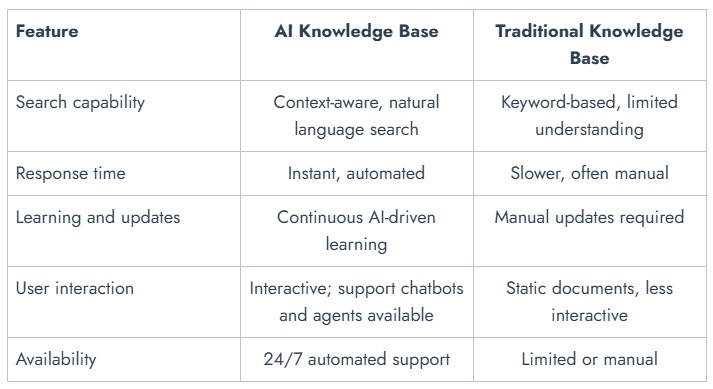
This comparison highlights that AI-powered knowledge bases offer a superior experience by understanding user intent, delivering real-time responses, and continuously improving. These advantages help organizations cut support costs and boost satisfaction for both customers and employees, explaining the shift away from traditional systems.
Conclusion
AI-powered knowledge bases represent a transformative tool for modern businesses striving to deliver top-notch customer support and efficient internal information management. By adopting AI knowledge base software, organizations can provide faster, more precise answers, empower self-service, and ease the load on support staff.
With ongoing learning and seamless integration with chatbots and support systems, an AI-powered knowledge engine becomes an invaluable asset for enhancing user experience and team productivity. As the demand for timely and relevant information rises, adopting such solutions is vital for maintaining competitiveness and meeting the evolving needs of customers and employees.