Agentic AI Platforms vs. Workflow Automation: What’s the Real Difference?
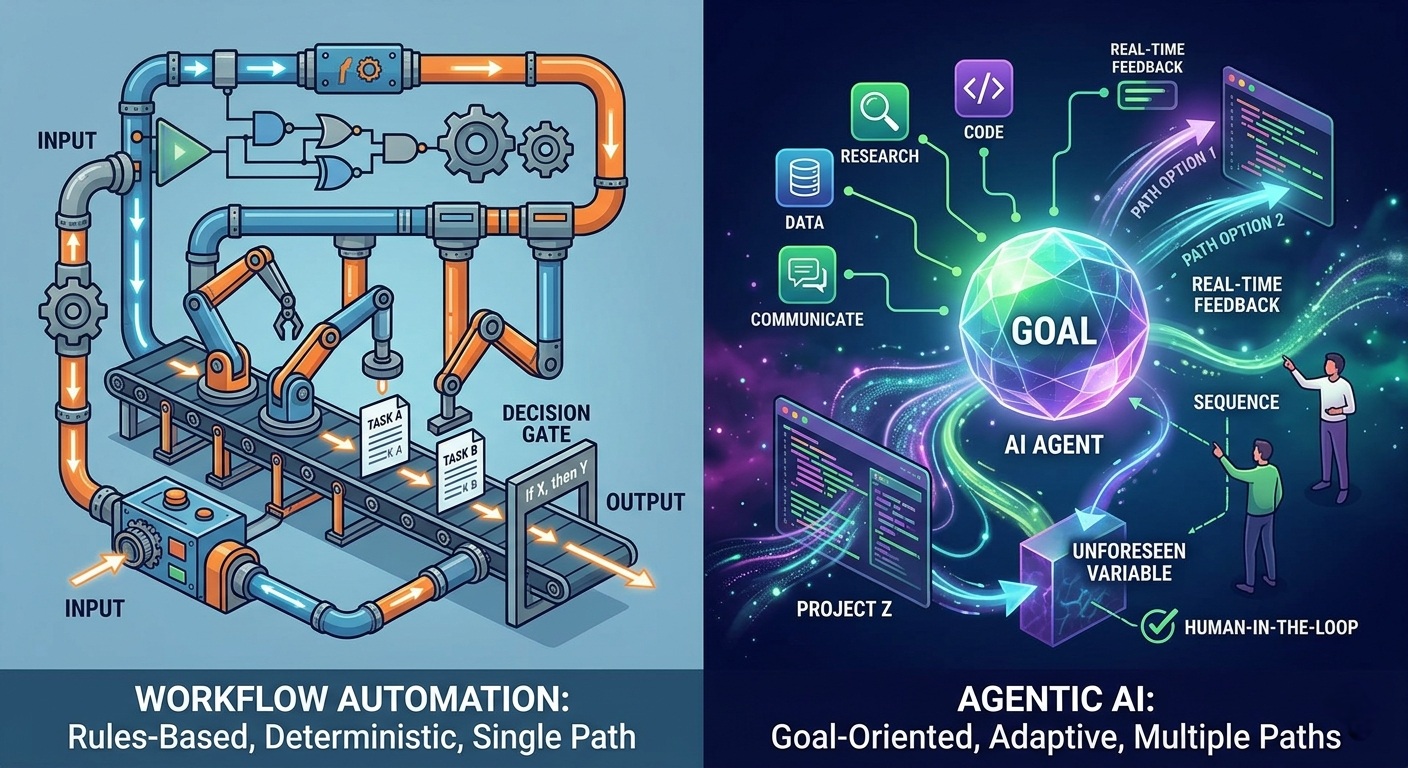
Agentic AI Platforms vs. Workflow Automation: What’s the Real Difference?
Understanding the Misconception
Many teams express the desire for an AI agent, but often what they initially create is a workflow system. During demonstrations, these systems may appear similar—handling tasks like ticket classification and action triggering—but the real test comes when the system encounters unclear requests, needs to select appropriate tools, or must pull context from various sources. The distinction becomes clear when language shifts from merely cosmetic to essential for system architecture.
The Rapidly Evolving Landscape
As the field progresses, a significant prediction emerged in August 2025: by 2026, 40% of enterprise applications will feature integrated, task-specific AI agents—an increase from under 5% in 2025. However, it’s also anticipated that over 40% of these projects may be abandoned by 2027 due to high costs, ambiguous value, or inadequate risk management. This guide aims to clarify the true nature of agentic AI platforms, how they differ from workflow automation, and why the distinction is crucial for successful system implementation beyond initial demonstrations.
Why the Confusion?
The confusion surrounding agentic AI does not stem from its complexity but rather from the broad use of the term “agentic AI platform” for various products. These can include workflow tools with AI components, builders for tool-utilizing agents, orchestration layers, or even environments for agent governance and deployment. The marketing allure of “agentic” as futuristic, contrasted with “automation” as reliable, further blurs the line. Gartner has termed this phenomenon "agent washing," where products are marketed under the agentic label without delivering the expected capabilities.
The Role of Workflow Automation
Workflow automation is not inferior; instead, it is a well-established technology. It excels in structured, repetitive processes where deterministic paths are advantageous. Common applications include processing invoices, routing support tickets, and managing lead forms. These workflows thrive on predictability and consistency, making them invaluable in operational settings.
However, issues arise when the system must handle variability, dynamically choose tools, or adapt plans based on intermediate results. As complexity increases, teams may resort to describing their workflows as agents, even though they remain fundamentally rule-driven.
What Makes a System Truly Agentic?
A system feels agentic when its next steps aren't predetermined. This doesn't imply total autonomy but rather working towards a goal with flexibility in execution. An agentic system interprets objectives, adapts to changes, and can choose among various tools and paths. For instance, while a workflow may route a procurement request based on fixed criteria, an agentic system evaluates the request, checks vendor history, and makes nuanced decisions on approval or escalation.
Defining an Agentic AI Platform
An agentic AI platform is where AI agents are developed, connected to tools and data, assigned goals, and deployed in business processes. It’s not just about generating responses but creating an environment where agents can reason, leverage tools, and operate within set boundaries.
Such platforms typically possess layers for reasoning, tool execution, context retrieval, state management, governance, and observability. These components ensure agents can operate dynamically while maintaining control and oversight.
Comparison: Workflow Automation vs. Agentic AI
While both workflow systems and agentic AI platforms can connect tools and trigger actions, their optimization differs. Workflow systems excel in predefined tasks with known conditions and outcomes. In contrast, agentic AI platforms are designed for tasks requiring real-time judgment, tool selection, and contextual adaptation.
For example, in handling customer queries about refunds, a workflow might follow a predetermined path, whereas an agentic system evaluates all relevant data, considers past interactions, and decides the next step dynamically.
Why the Distinction Matters
In production, systems face unpredictable data and scenarios. While workflows shine in controlled environments, real-world applications often necessitate agent-level controls like decision visibility, access restrictions, and human oversight. This is crucial in domains like customer service, IT support, and procurement, where ambiguity must be managed without compromising safety.
Key Features of a True Agentic AI Platform
For a platform to be genuinely agentic, it must offer goal-based design, dynamic tool interaction, context management, decision tracing, and governance. These features enable a system to operate effectively and safely in production environments.
When to Choose Workflow Automation vs. Agentic AI
Opt for workflow automation when tasks are repetitive and structured, ensuring consistency. Choose an agentic AI platform when tasks require goal interpretation, dynamic tool selection, and recovery from unexpected scenarios. Most enterprise systems will benefit from integrating both approaches, leveraging workflows for deterministic tasks and agentic platforms for those requiring more nuanced execution.
Looking Ahead
The landscape is evolving, with agents becoming integral to enterprise applications. By 2026, a significant portion of applications will incorporate AI agents, although many projects may falter if they fail to differentiate between workflows and agentic systems. Future platforms will likely emphasize orchestration, governance, and safe AI integration, moving away from vague agentic claims towards practical, robust solutions.
Conclusion
While workflow automation remains a cornerstone of enterprise software for structured tasks, agentic AI platforms are essential for tasks requiring dynamic problem-solving. Understanding these distinctions is crucial for developing systems that can adapt and thrive in complex, real-world environments. The choice of platform is not just about the model but about providing agents with the necessary context, controls, and operational framework.